Pythagorean Theorem proof and applications
History of Pythagorean Theorem
Pythagoras (born between 580 and 572 B.C., died about 497 B.C.) was born on the island of Samos(Asia). He was the earliest important philosopher who made important contributions in mathematics,astronomy and the theory of music.
Pythagoras is credited with introduction the words “philosophy,” meaning love of wis-dom and “mathematics” - the learnt disciplines.Pythagoras is famous for establishing the theorem under his name: Pythagoras’ theorem, which is well known to every educated person. Pythagoras’ theorem was known to the Babylonians 1000 years earlier but Pythagoras may have been the first to prove it.
Proof of Pythagorean Theorem
Proof of Pythagorean Theorem in mathematics is very important.
In a right angle,the square of the hypotenuse is equal to the sum of the squares of the other two sides.
States that in a right triangle that the square of a (a²) plus the square of b (b²) is equal to the square of c (c²).
In short it is written as: a² + b²= c²
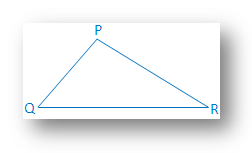
Let QR = a, RP = b and PQ = c. Now, draw a square (WXYZ) of side (b + c). Take points E, F, G, H on sides WX, XY, YZ and ZW respectively such that WE = XF = YG = ZH = b.

Then, we will get 4 right-angled triangle, hypotenuse of each of them is ‘a’: remaining sides of each of them are band c. Remaining part of the figure is the square EFGH, each of whose side is a, so area of the square EFGH is a².
Now, we are sure that square WXYZ = square EFGH + 4 ∆ GYF
or, (b + c)²= a² + 4 ∙ 1/2 b ∙ c
or, b²+ c² + 2bc = a² + 2bc
or, b²+ c²= a²
Proof of Pythagorean Theorem using Algebra:

Given: A ∆XYZ in which ∠XYZ = 90°.
To prove: XZ²= XY²+ YZ²
Construction: Draw YO ⊥ XZ
Proof: In ∆XOY and ∆XYZ, we have,
∠X = ∠X → common
∠XOY = ∠XYZ → each equal to 90°
Therefore, ∆ XOY ~ ∆ XYZ → by AA-similarity
⇒ XO/XY = XY/XZ
⇒ XO × XZ = XY² ----------------- (i)
In ∆YOZ and ∆XYZ, we have,
∠Z = ∠Z → common
∠YOZ = ∠XYZ → each equal to 90°
Therefore, ∆ YOZ ~ ∆ XYZ → by AA-similarity
⇒ OZ/YZ = YZ/XZ
⇒ OZ × XZ = YZ² ----------------- (ii)
From (i) and (ii) we get,
XO × XZ + OZ × XZ = (XY² + YZ²)
⇒ (XO + OZ) × XZ = (XY²+ YZ²)
⇒ XZ × XZ = (XY² + YZ²)
⇒ XZ² = (XY² + YZ²)
👍🏻👍🏻
ReplyDelete👌👌
ReplyDelete